Role Builder

Don’t write the job description. Answer a few questions.

Type a role title. We pre-fill the skills the market actually asks for and the salary band it actually pays — you tick, we write it. A complete, publishable job description in about a minute. Free, no signup, yours to keep.

Build my role — free Book a live demo
No signup — and the moment it’s written, we match it against real people
1

Give us a title

“Data Analyst” is enough. Add a location if it matters, or leave it blank for remote.

2

Nod at the defaults

The must-have skills and the salary band arrive pre-filled from the live market for that role.

3

Add anything of yours

Your own requirements, in your own words. However specific — they all make the final copy.

4

Get the description

A finished, publishable job description — and, if you want it, a shortlist of people who fit it.

The prefill is the product

It already knows what the role needs.

The hard part of writing a job description isn’t the prose — it’s knowing what to ask for and what to pay. So that part is answered before you start. Enter the title and the builder fills itself from live market data for that role: the skills employers are genuinely asking for, the ones worth considering, and the salary band that goes with them.

  • Essential skills pre-ticked, drawn from real employer demand
  • Desirable and emerging skills you may not have thought of
  • A market salary band for that title, before you commit to one
  • Change anything — the defaults are a starting point, not a cage
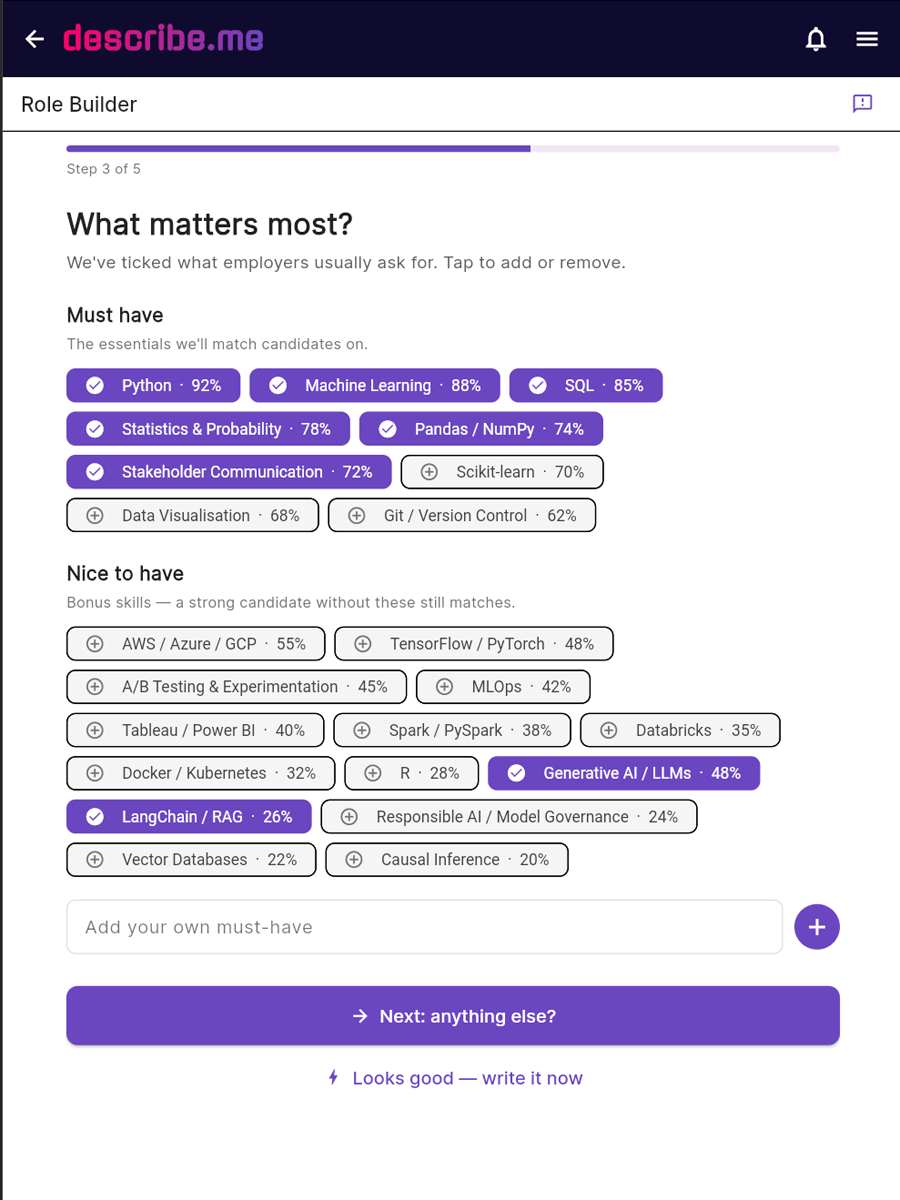
describe.me Role Builder — entering a role title pre-fills the essential skills employers ask for and a market salary band
Market-prefilled skills
Preview coming soon
Nothing invented

The thing most AI job description generators get wrong.

Ask a generic writing tool for a job description and it will cheerfully promise a generous pension, a collaborative culture and a close-knit team — for a company it knows nothing about. That puts words in your mouth in a document people make life decisions on. Ours states only what you supplied. Give it a thin brief and you get a short job description, which is the right answer.

  • No invented benefits, culture, team size or interview stages
  • No years-of-experience bar unless you set one
  • Salary stated plainly — never dressed up as “competitive”
  • Nothing you asked for is quietly dropped, however unusual
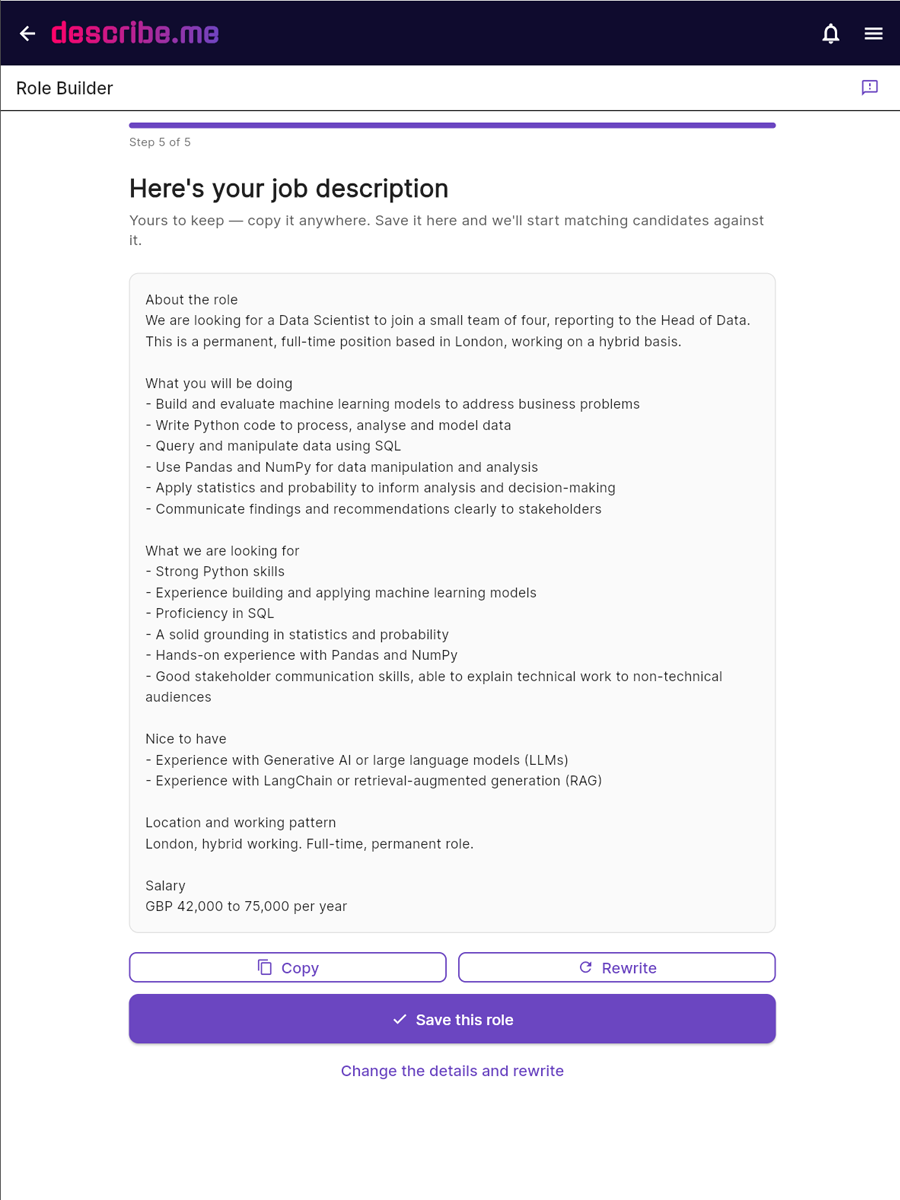
describe.me Role Builder — the finished job description, containing only the facts the employer supplied
The finished description
Preview coming soon
The rules it writes to

Two rules, and they’re not negotiable.

One about what it must never add. One about what it must never drop.

It never invents

  • Benefits, pension or holiday you didn’t mention
  • Company history, mission, funding or team size
  • Interview stages, start dates or reporting lines
  • Age-coded or gender-coded wording — no “young and energetic”, no “rockstar”, no “ninja”
  • Corporate clichés: no “fast-paced environment”, no “wear many hats”, no “we’re like a family”

It never drops

  • Every essential skill you ticked appears in the finished description
  • Every note you wrote is reflected somewhere in it
  • Unusual requirements stay in — must own a van, must be a keen baker, whatever it is. It’s your role
  • The one exception: wording that would be unlawful to advertise under the Equality Act 2010 is left out
  • Plain, warm British English — “CV”, never “resume”
What you get back

A job description you could publish as it stands.

Not a template with blanks in it. A finished document, structured the way candidates actually read one.

Six clear sections

Each one on its own, in the order people read them:

  • About the role
  • What you will be doing
  • What we are looking for
  • Nice to have
  • Location and working pattern
  • Salary

Real responsibilities

Four to six bullets describing what the person will actually do — drawn from the role and the skills you chose, not from a stock library of filler.

Requirements people can self-assess against

Must-haves separated cleanly from nice-to-haves, so the right people apply with confidence and the wrong ones rule themselves out early.

Wording that won’t land you in trouble

Written to steer clear of age-coded, gender-coded and other wording the Equality Act 2010 takes a dim view of. Read it before you post it — but it starts from the right place.

Yours to keep

Plain text you can paste into a job board, your careers page or your ATS — whatever you decide to do next, and whether or not you hire through us.

It’s also the input to matching

The description is the text our matching engine reads. Writing it here means it’s dense in the terms that carry real signal — so the shortlist that follows is sharper.

Every other job description generator hands you a document. This one hands you people.

The moment your description exists, it runs against our live pool of opt-in professionals — and about a minute later you have an anonymised, scored shortlist: match quality, Staying Power, essential skills covered, and how your offer compares to the market. No agency fee. No signup to look.

Write it and see who fits
Free · no account needed · the description is yours either way

The bit of the job an agency charges you for.

Written properly, in about the time it takes to make a coffee.

~1 min Title in, description out
6 Sections, publish-ready
0 Invented facts about you
£0 To use, no signup
Straight answers

How to write a job description, without writing it

Is it free?

Yes. Free to use, no account and no card — and the finished job description is yours to keep and publish wherever you like, whatever you decide to do next.

Do I need to sign up?

No. Enter a role title, tick the must-haves and we write it. You only create an account if you later want to unlock a candidate’s contact details.

Will it invent things about my company?

No, and that’s deliberate. It states only what you supplied — no invented benefits, culture, team size or interview stages. A thin brief gives you a short description rather than a padded one.

Where do the skills and salary come from?

From live market data for that role title — the skills employers are actually asking for, with real demand behind them, plus the market salary band. Accept them, remove them, or add your own.

Is the wording legally safe?

It’s written to avoid the wording that gets employers into trouble under the Equality Act 2010 — no age or gender-coded language, no years-of-experience bar unless you set one. You’re the publisher, so always read it before you post it.

What if my role is unusual?

Every essential requirement you give it appears in the finished description, however specific. It isn’t allowed to decide one of your requirements is unimportant and quietly drop it.

Where the suggestions come from: skills and salary bands are drawn from aggregated market data for that role title — indicative guidance to help you position the role well, not a guarantee. Everything is editable, and the finished description contains only what you supplied. Read it over before you publish it: you know your company, and we deliberately don’t guess.

Start with a title. We’ll do the rest.

A publishable job description in about a minute, then a free anonymised shortlist of people who genuinely fit it. No agency, no signup, no fee to look.

Build my role — free
Or book a live demo See pricing — pay only on agreed contact

The complete hiring workflow

Write the role · Match the people · Back the ones who’ll stay · Get them in the room · Know what to ask

Candidates' data stays theirs. Every contact is gated on the candidate's explicit consent. Read the data promise