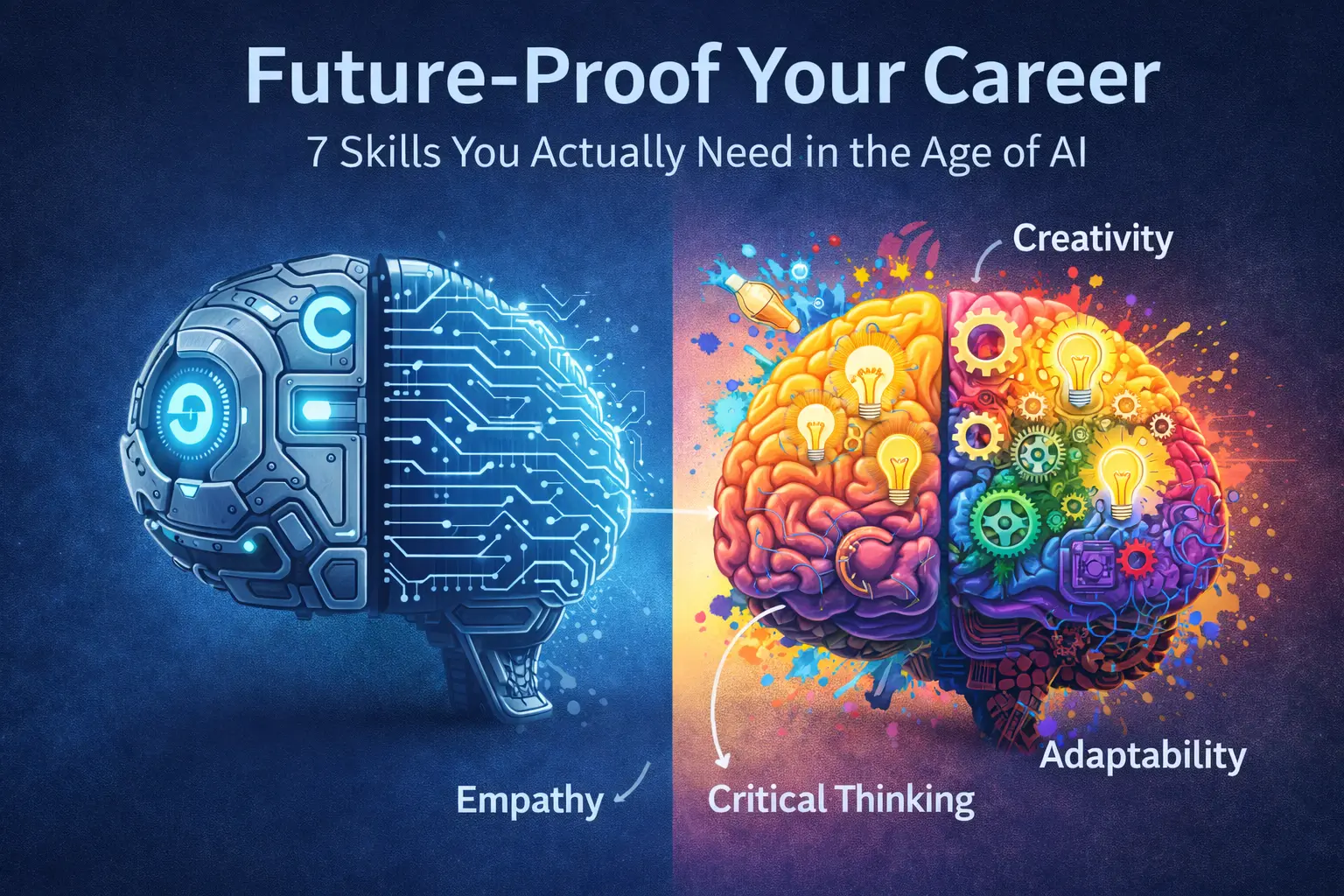
Let's be honest. If you've searched for career advice lately, you've probably been buried under a mountain of vague reassurances ("just be adaptable!") or terrifying predictions ("AI will take your job by Thursday!"). Neither is particularly useful when you're a working professional trying to make smart decisions about your career right now.
So let's cut through it. The UK is in the middle of a genuine skills transformation. AI adoption could contribute up to £400 billion to the UK economy by 2030, according to the government's AI Opportunities Action Plan. But Skills England's own research found that 61% of UK employers currently have no staff working with AI, and over half rate their organisation's AI knowledge as "beginner" or "novice". That gap between where the economy is heading and where most workers are today? That's your opportunity.
The good news: future-proofing your career doesn't mean becoming a machine learning engineer (unless you want to). It means developing a deliberate mix of skills that make you more valuable because AI exists — not in spite of it.
The skills that actually matter (according to 1,000 employers)
The World Economic Forum surveyed over 1,000 global employers for their 2025 Future of Jobs Report. The findings challenge a lot of assumptions. Yes, AI and big data skills are growing fastest. But the top core skill employers identified — the one 7 out of 10 companies rated as essential — was analytical thinking. Not Python. Not prompt engineering. The ability to look at a problem, break it apart, and reason through it clearly.
The rest of the top five? Resilience and adaptability, leadership and social influence, creative thinking, and self-awareness. These aren't soft, fluffy add-ons. They're the skills that determine whether someone can actually use technology to create value — or just watch it happen around them.
What follows are the 7 skills that came up again and again across the research, the employer surveys, and the real hiring patterns we're seeing in the UK market. Each one includes a concrete action you can take immediately — because knowing what to do is useless without knowing how to start.
1. Analytical Thinking
This is the skill that sits at the top of every major employer survey for a reason. Analytical thinking is the ability to examine information critically, identify patterns, distinguish signal from noise, and make sound decisions under uncertainty. In a world where AI can generate answers to almost any question in seconds, the ability to ask the right question — and evaluate whether the answer actually makes sense — is more valuable than ever.
This isn't about being a data scientist. A marketing manager who can interrogate campaign metrics, a project lead who can spot the real bottleneck behind a missed deadline, a salesperson who can read between the lines of a client's objections — they're all using analytical thinking. It applies everywhere.
2. AI Literacy (Not AI Mastery)
Here's where a lot of people get tripped up. You don't need to build AI models. You need to understand what AI can and can't do, how to use it effectively in your work, and when to trust its outputs versus when to override them. Think of it like driving a car: you don't need to be a mechanic, but you do need to know the rules of the road and how the controls work.
In the UK specifically, this is a huge opportunity. The government's AI Skills report found that 73% of UK employees haven't used AI in the past month, and only 19% feel confident using it safely. That means if you develop even a working familiarity with AI tools — using them daily, understanding their strengths and limitations — you're immediately ahead of the vast majority of the workforce.
3. Creative Problem-Solving
AI is extraordinarily good at optimising within known parameters. It's terrible at reframing the problem entirely. When a business faces a challenge it hasn't encountered before — a new competitor, a market shift, a regulatory change — the person who can look at the situation from an unexpected angle and propose a genuinely novel solution is irreplaceable.
Creative thinking ranked fourth among the WEF's top core skills, and it's rising fast. This isn't about being "artistic". It's about the ability to connect ideas across different domains, challenge default thinking, and generate options that weren't on the table before. The more routine work AI absorbs, the more your value shifts to the non-routine problems that require genuine creativity.
4. Resilience and Adaptability
The pace of change isn't slowing down. The WEF projects that the skills needed for most roles will shift substantially over the next five years, and the UK labour market is already feeling it — with hiring patterns, role definitions, and even entire industries evolving faster than most career plans account for.
Resilience isn't about gritting your teeth and pushing through. It's the ability to absorb a setback, recalibrate, and move forward without losing momentum. Adaptability is its close cousin: the willingness to adjust your approach when circumstances change, rather than clinging to a plan that no longer fits. Together, they're the foundation that makes all other skill development possible.
5. Communication and Translation
As AI becomes embedded across organisations, one of the most valuable people in any room will be the one who can translate between technical and non-technical worlds. The person who can explain what the data actually means to the board. The one who can articulate business needs to the engineering team in a way they can act on. The one who can take a complex AI output and turn it into a clear recommendation.
This is especially true in the UK, where the AI skills gap isn't just about technical ability — it's about comprehension. If you can help your team or organisation understand what AI makes possible and where the risks lie, you become the bridge between potential and execution. That's a career-defining position to hold.
6. Leadership and Collaboration
Leadership in the age of AI doesn't mean having all the answers. It means creating the conditions where your team — which increasingly includes AI tools alongside human colleagues — can do its best work. It means making decisions under uncertainty, aligning people around shared goals, and navigating the human dynamics of change.
You don't need a management title to develop this. Leading a project, mentoring a junior colleague, facilitating a difficult conversation, or simply being the person who keeps things moving when everyone else is stuck — these are all leadership acts. The WEF placed leadership and social influence as the third most important core skill for employers right now. It's that central.
7. Curiosity and Continuous Learning
This might be the most important skill on this list, because it's the one that unlocks all the others. The WEF identified curiosity and lifelong learning as one of the fastest-rising skills globally. In an environment where technology shifts every few months, the professionals who stay relevant aren't the ones who learned the most ten years ago — they're the ones who never stopped learning.
Curiosity also makes you better at everything else on this list. Curious people ask better analytical questions. They explore new AI tools earlier. They're more adaptable because they're genuinely interested in what's coming next rather than threatened by it. In the UK, where 54% of firms report difficulty filling entry-level digital roles, professionals who proactively build new capabilities will always be in demand.
The real pattern: it's the blend that wins
If you've noticed a theme across these seven skills, you're already thinking analytically. The professionals in highest demand aren't purely technical and they aren't purely "soft-skilled". They're hybrid — people who can use AI fluently while thinking critically, communicate technical concepts clearly, lead through change with resilience, and bring creative solutions to novel problems.
PwC's Global AI Jobs Barometer found that workers who combine AI skills with domain expertise are seeing salary premiums of up to 56%. Meanwhile, UK tech demand continues to outstrip supply, with over 90% of global companies expected to face IT skills shortages through 2026. The shortage isn't just for coders — it's for people who can work effectively in AI-augmented environments across every industry.
Where to focus first
Seven skills is a lot. You don't need to tackle them all simultaneously. Here's a practical approach: start with the one that's closest to a gap you're already feeling. If you're uncomfortable with AI tools, start with Skill 2. If you're technically strong but struggle to communicate your ideas, Skill 5 will give you the biggest return. If you've been in the same role doing the same things for years and feel stuck, Skill 4 (adaptability) is your entry point.
The important thing is to start. Every week you invest in deliberately building these capabilities is a week you're moving ahead of the professionals who are waiting for things to settle down. Things aren't settling down. The pace of change is the new normal, and your ability to navigate it well is the most career-defining skill you can develop.
Make your skills visible
Building skills is one thing. Making sure the right opportunities find you is another. The professionals who thrive in the age of AI aren't just skilled — they're visible. They articulate what they can do, where they want to go, and what kind of work energises them. When you define your career aspirations alongside your capabilities, you're not just passively job hunting — you're actively shaping the trajectory of your career.
That's the approach we built describe.me around. Rather than endlessly scrolling job boards, you invest 5 minutes in defining your skills and aspirations, and let matching opportunities come to you. Because in a market that rewards the skills we've discussed here — analytical thinking, adaptability, communication, curiosity — the smartest move is to spend your time developing those skills, not searching through hundreds of irrelevant listings.
Share this article