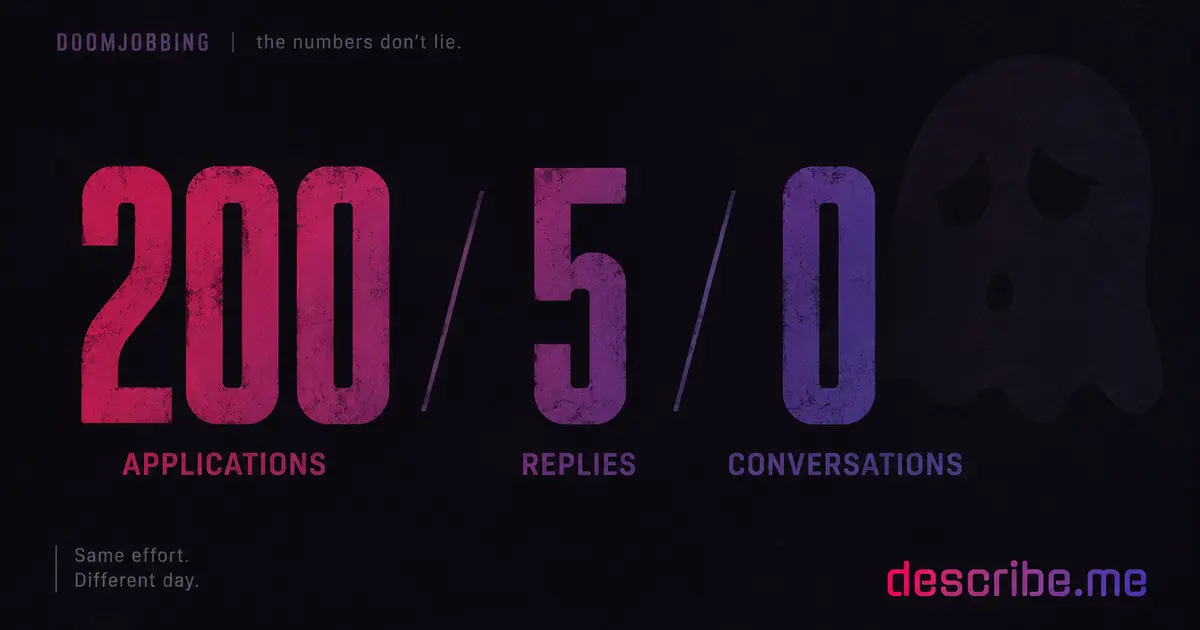
Doomjobbing has a name now. It's the dread cycle of the modern job search: 200 applications sent, two replies received, the other 198 swallowed by a system that never had any intention of answering. Recruitment commentators are calling it a Gen Z resilience problem. It isn't. It's a verdict on a funnel that has been quietly punishing care and rewarding spam for years. This is what doomjobbing actually is, why it happened, and the platform we've been building since 2024 on the opposite assumption.
What Doomjobbing Actually Means
Doomjobbing is the act of applying for roles you already expect to ghost you. You scroll, you apply, you don't tailor anymore because tailoring made no difference last time. You rewrite the same paragraph for the hundredth time. You stop reading the job description after the salary band, if there even is one. You hit submit, and you feel nothing, because you have already priced in the rejection.
The press has framed it as a TikTok term for jaded young professionals. That framing lets the industry off the hook. The truth is that doomjobbing is what happens when a rational person meets an irrational system enough times. The behaviour is the symptom. The funnel is the disease.
The Numbers Behind the Dread
250
Applications per role posting
3%
Of applicants get an interview
3x
Applications per hire since 2021
Companies now receive an average of 250 applications per posting, and only 3% of applicants ever get an interview. Applications per hire have tripled since 2021. If you feel like you are shouting into a hole, that is because, statistically, you are.
Then there is the AI screening layer. 87% of companies now use AI in recruitment, and 66% of professionals say they would rather walk away than be screened by an AI-only process. So the median experience now is: your CV, written by you (or by ChatGPT), is being judged by a model that nobody on the hiring side fully trusts either, while the candidate on the other side has already lost faith in the verdict.
And the time costs sit on the recruiter side too. 80% of recruiter time is spent on non-strategic tasks, mostly screening through the same flood that doomjobbers created when they stopped tailoring. Everyone is busier. Nobody is happier. Nothing is better matched.
Five Design Choices That Built the Doomjobbing Funnel
Doomjobbing did not appear out of nowhere. It is the predictable output of five recruitment design choices that looked efficient on a slide and turned out to be corrosive in practice.
1. The keyword ATS
Applicant tracking systems were sold as a way to surface the best candidates. In reality they reward whoever writes a CV that looks most like the job advert. That is not a well-matched candidate. That is a candidate with a thesaurus. Skills, judgement, and trajectory all become invisible to the first gate, so candidates learn to game it. So do scammers.
2. The ghost role
A meaningful share of postings are not real openings. Some are "evergreen" pipeline-builders. Some exist to be seen to be hiring. Some are placeholders for an internal candidate already chosen. A candidate who applies to ten roles and finds out later that two of them never had a vacancy at all has not learned a lesson about their CV. They have learned a lesson about who to trust.
3. AI-only screening
Sort by an algorithm that nobody can fully explain, reject by the same algorithm, then act surprised when the Workday discrimination lawsuit and 66% of candidates say no thanks. The legal exposure is landing now. The trust collapse landed years ago.
4. Rejections signed by nobody
"We regret to inform you that on this occasion." No name. No human. No information. Often weeks after the role closed. Often automated to the second. Treat candidates like a queue ticket and they will treat your roles like a queue. That is what doomjobbing actually is at scale: people who have been taught that careful application is wasted effort, behaving accordingly.
5. The "tailor every CV" lie
Career advice still tells professionals to tailor every CV and cover letter. Then most CVs are screened by software that does not read the cover letter, and matched on keywords that the candidate cannot see. The advice is honest about the work required and dishonest about what happens to it.
Built five design choices that punish care, then call the people breaking under them "entitled".
The Fix We've Been Building Since 2024
describe.me was registered in 2024 with a single thesis: the modern job search is broken because it optimises the wrong thing. It optimises for application volume, when the thing that actually matters to both sides is the quality of the match. Build a platform that optimises for match quality instead, and the doomjobbing dynamic disappears, because there is nothing for it to feed on.
The first version of the app went live around eighteen months ago. It was, candidly, basic. The thesis was right; the implementation needed to grow up. What follows is what's shipped since, and how it directly counters each of the five broken design choices above.
Aspiration-first profiles, not keyword CVs
Traditional recruitment asks "what have you done?" describe.me asks "where do you want to go?" first. A describe.me profile captures your skills and your career aspirations side by side, then uses both. You define the role you want before the system shows you the roles that exist, which makes the matching honest in both directions.
Multi-layer semantic matching, not keyword bingo
Our Smart Matching engine works in layers: a granular skills match (essential and desirable, scored separately), a semantic profile match that understands the meaning of experience rather than its wording, and a composite score that recruiters can drill into line by line. No black box. No keyword arms race. A senior professional whose CV does not happen to contain the word "stakeholder" stops being invisible.
Opportunities find you, not the reverse
You don't apply on describe.me, recruiters reach out to you. The default state is passive, which matters because 70 to 75% of the workforce are passive candidates who would entertain the right role but will not join the application lottery. By making the platform work for the passive majority, the active job-search crisis gets defused at source.
Pay-per-contact, not pay-to-spam
Recruiters on describe.me pay when they decide a candidate is worth contacting. That single design choice realigns the economics of the platform: spam costs money, so it stops. Selectivity is rewarded. A message in your inbox from a describe.me recruiter means someone has read your profile, decided you genuinely fit, and put their own commercial skin in the game. It is the precise opposite of an Easy Apply auto-rejection.
Honest "no" or no "no" at all
No application black hole, because there is no application. Either a recruiter reaches out or they don't. If they don't, you haven't wasted half an evening tailoring something that was never going to be read. The whole anxiety loop that doomjobbing depends on simply has nowhere to start.
What This Looks Like in Practice
You spend about five minutes describing your experience, your skills, and the role you actually want next. Profile created. From that point on, your time goes back to your career. The platform works in the background. When a recruiter searching for your specific blend of skills and aspirations finds you, they reach out, with a real role, at a real company, with a real salary. You decide whether to engage. That is the entire candidate experience. The dread has nowhere to live.
What Recruiters Need to Do Too
Doomjobbing is not just a candidate-side problem to fix. Recruiters benefit when the system stops rewarding spam, because the noise on the recruiter side disappears at the same time. The signal at our end is that skills-based hiring produces 94% better predictions of job success than CV screening, with reported gains of 90% improved diversity, 91% improved retention, and 78% lower cost-to-hire for organisations that adopt it properly. Skills and aspirations are not soft signals. They are the most predictive signals there are.
If you run a TA function, the practical asks are short. Stop posting roles you have no intention of filling. Replace keyword screening with skills-and-aspiration matching. Sign your rejections with a name. And look at where your active candidates are coming from, because the strongest 70% of the workforce you want to hire are not in your ATS funnel at all. They are passive, and they are the people describe.me is built around.
A Better Question Than "How Many Did You Send?"
The number of applications you sent this month is not a measure of effort. It is a measure of how much the system has taught you to mistrust it. The professionals who are succeeding right now are not the ones sending more, they are the ones who have stopped sending into the void and started building a profile that is searchable on the things they actually care about.
Doomjobbing has a name because the dynamic finally became undeniable. The next chapter is not about candidates becoming more resilient to a broken funnel. It is about replacing the funnel with something that does not require resilience to survive.
We've been building it since 2024. The fix is here. You just have to stop applying for permission to be considered.