In January 2026, Eightfold AI was named in a class action alleging it kept secret 0–5 scores on candidates and used them to filter people out before any human ever saw the file. Workday's Mobley class action is moving forward on a parallel theory. And a recent survey found that 50.5% of professionals were rejected in the last year without a single human reading their application. We didn't build describe.me as another point on that spectrum. We built it as the opposite of it. Here's exactly how, and the line we will not cross.
The Pattern That's Driving the Lawsuits
The hiring AI category that's now under legal pressure was designed around one assumption: that the bottleneck in recruitment is reading too many applications, so the answer is software that decides which ones a human bothers to look at. In practice that has meant three things, all repeating in courtrooms and trade press through 2025 and 2026:
Hidden scores. A number is generated about you, filed against you, and you are never shown it. The Eightfold complaint frames these as the equivalent of credit reports compiled without consent.
Auto-rejection at the gate. The lowest-scored candidates are removed from the shortlist before any recruiter sees them. The candidate experiences this as silence. They don't know why they were rejected. They don't know they were rejected by software at all.
Opaque criteria. The model uses signals candidates were never told mattered: scraped social activity, geography, application velocity, sometimes inferences from names or schools. When challenged, vendors tend to describe the system as "AI-powered" without explaining what specifically the AI is doing or how a candidate could ever appeal it.
That is the system the Wired story about Dartmouth medical student Chad Markey crystallised in May, when he wrote that his worth as a candidate now depended on his ability to "filter myself through a series of automated gateways". The Mobley and Eightfold cases will run for years. The reputation damage to this entire category of product is already done.
describe.me Is Not an ATS. We're Something Different.
Before going into how our matching works, the category point matters. An applicant tracking system sits inside an employer's hiring funnel. Candidates apply through it. Software inside it parses and ranks those applications. The recruiter sees what the software shows them. That is the architecture every one of the lawsuits above is challenging.
describe.me is not that. We are a career development platform that recruiters come to. Candidates do not apply through us. They build a profile that captures their skills, their experience, and the role they actually want next. From that point on, recruiters search the platform for people who match what they're hiring for, and reach out directly. There is no application funnel. There is no application to filter. The whole "AI rejects you before a human sees you" failure mode does not exist on describe.me, because there is nothing for it to reject.
That is a different category of product. Closer to a passive candidate marketplace than to anything sitting inside a hiring funnel. It is also why the rest of this piece is not "an ATS, but ethical". It is a different design from the ground up.
How Our Smart Matching Actually Works
When a recruiter searches describe.me for candidates, our Smart Matching engine runs several layers. Every layer is visible. Every score is shown to both sides. The recruiter makes every contact decision. Here is what that looks like, screen by screen.
1. The ranked match list
When a recruiter opens a role, they see a ranked list of candidates with a match percentage and a skills count. The percentage and count are calculated, not invented. The recruiter is choosing whom to look at next, but no candidate has been removed from the list to make that decision easier.
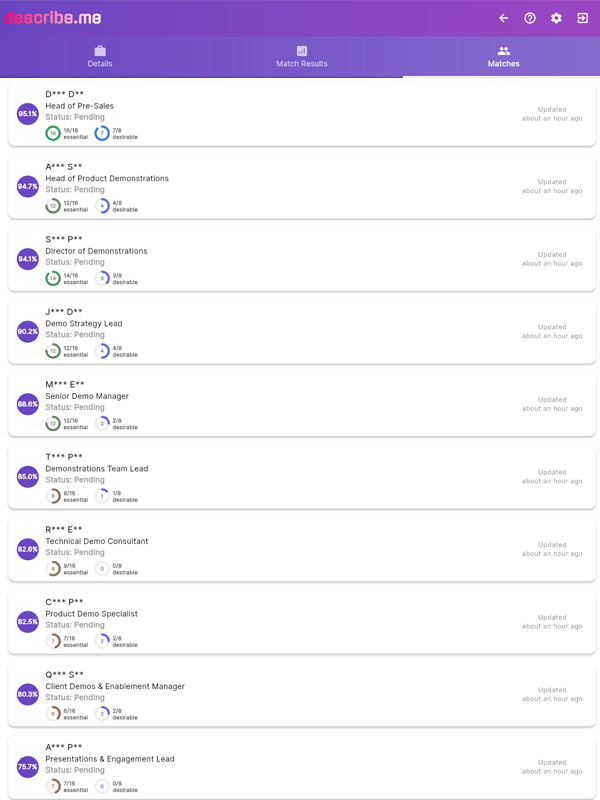
Ranked match list. AI ranking, no auto-removal.
2. The skills breakdown
For each candidate, essential and desirable skills are separated and matched explicitly. The recruiter sees which specific skills the candidate has and which the candidate doesn't, with the candidate's own wording shown alongside the role requirement. This is what "explainable" actually looks like, instead of being the marketing word every vendor uses.
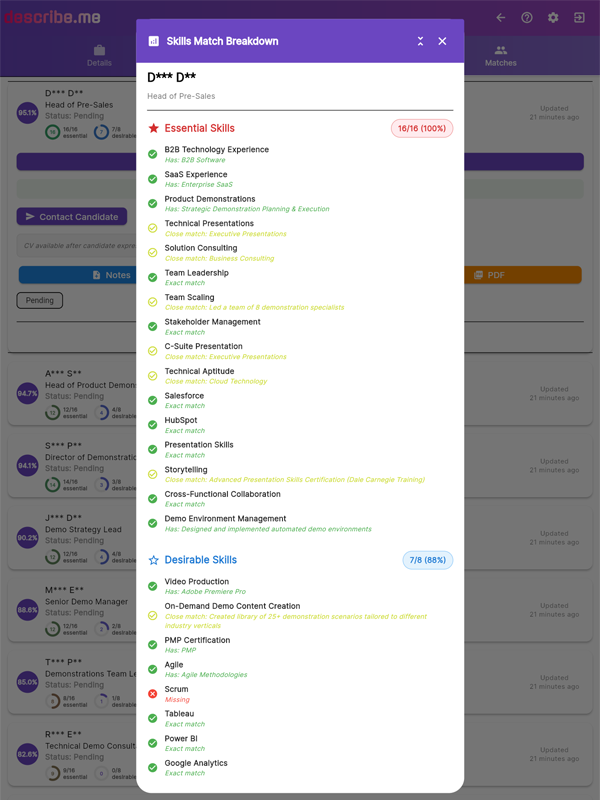
Skills breakdown. Every match is justified by named skills.
3. The score calculation
The composite score is shown as its parts: an AI semantic match (does the candidate's profile mean what the role is asking for, even if the words differ), the skills adjustment (how the explicit skills match modifies the semantic score), and the final composite. This is the screen most "AI hiring" tools refuse to show. It is the screen we lead with.
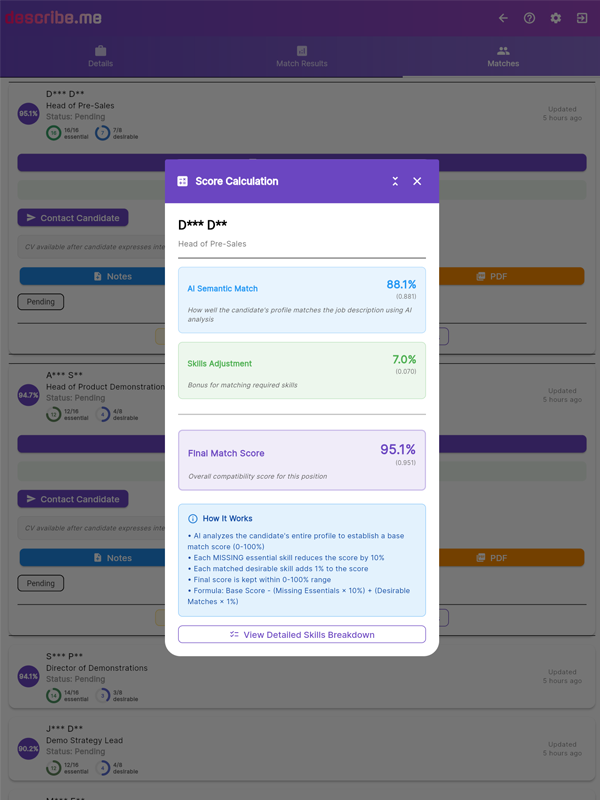
Score calculation. Visible to recruiter and candidate.
4. The match results dashboard
The recruiter view aggregates how the talent pool was filtered, which skills appeared most often, and where each candidate sits in the funnel. The recruiter still chooses, one by one, who to reach out to. The platform does not message candidates on their behalf and does not eliminate candidates from the dashboard before they get there.
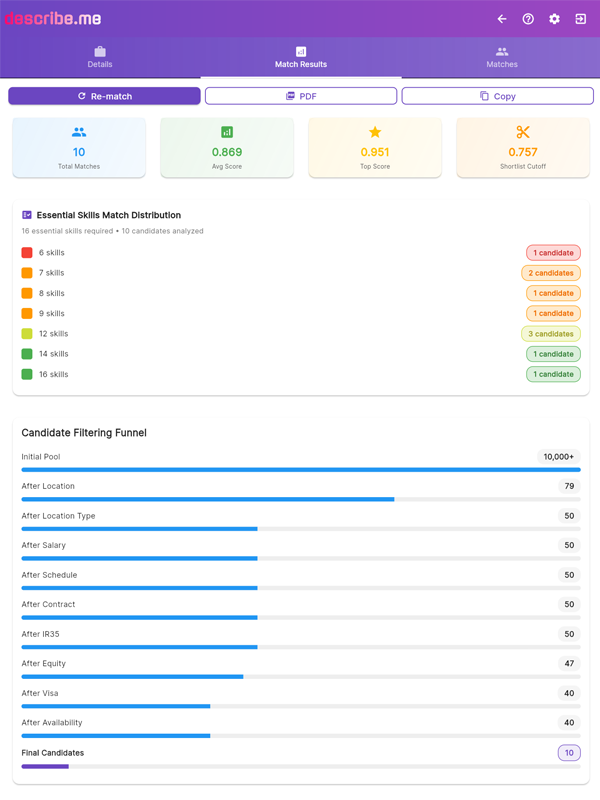
Match results dashboard. The recruiter is in the loop, not on top of it.
Who Decides What: A Plain-English Table
"Human in the loop" has become the most overused phrase in recruitment AI, used to mean almost anything. So here, plainly, is who does what on describe.me.
| Decision | Who makes it |
|---|---|
| Generate a match score for a candidate against a role | AI (recommendation) |
| Show the score to the candidate and to the recruiter | Always shown to both |
| Decide which candidates to contact | Recruiter |
| Decide which roles to be visible for | Candidate |
| Auto-reject anyone | Nobody. Ever. |
Zero automatic rejections. Every contact decision is made by a human. Every score is visible to the candidate it describes.
Filters That Work for You, Set by You
The one place candidates are filtered out of search results is when the role doesn't meet criteria they themselves set. That distinction matters, because it is the precise opposite of the Eightfold model. On describe.me, a candidate sets:
- The minimum salary they will consider
- The locations they will work in (and whether they'll relocate)
- The role types they want next
- Working pattern (full-time, part-time, contract)
- Industries to include and exclude
If a candidate's salary floor is £75k, they will not be surfaced for £45k roles. If they will not relocate from Manchester, they will not appear in London-only searches. This is not a hidden filter applied by the platform. It is the candidate exercising consent and saving themselves from irrelevant outreach. Recruiters benefit too: every candidate they see is a candidate who would actually consider the role.
This flips the consent question on its head. The Eightfold complaint is essentially: "you scored me, filed it, and never told me, and used it to keep me away from work I might have wanted." The describe.me design is: "we showed you your score, you set the rules for who can find you, and we respected them." Same word, opposite architecture.
What This Means for Recruiters
For TA leaders watching the lawsuits land, the practical reality is that "the AI ranked them so I shortlisted them" is an increasingly weak position to be in legally and reputationally. Defensible recruitment in 2026 requires three things at minimum: an explainable score, a documented human decision at every contact point, and candidate-side transparency about what's happening.
describe.me gives you all three by default, because we built the architecture around them rather than retrofitting compliance. Every shortlist you act on is yours. Every candidate on it can see why they're there. Every candidate who isn't there isn't there because they themselves said so, not because we filed a hidden score against them.
What This Means for Candidates
You are not in an application funnel on describe.me. You are in a marketplace where recruiters come looking for the skills and the aspirations you've defined for yourself. Your profile is yours. Your match score is yours to see whenever someone has searched against you. The roles you're surfaced for fit the rules you set, not rules someone set for you.
The dread cycle of sending applications into automated black holes does not exist here. There is nothing to send. There is no black hole to send it into. There is just a profile, a search, and a recruiter who decided you were worth a real message about a real role.
AI recommends. Humans decide. That's not a slogan. It's the architecture. You can see the scores, you can set the rules, and a person, not a model, decides whether to talk to you. We will not cross that line.
Further reading
- How Smart Matching works (full product walkthrough)
- How describe.me works: skills and aspiration matching in 5 minutes
- Doomjobbing: Why Job Hunting Broke (And the Fix We've Been Building Since 2024)
- The AI Recruitment Crisis: Why Humans Still Hold the Key to Hiring
- Your data on describe.me: what we hold and how you control it